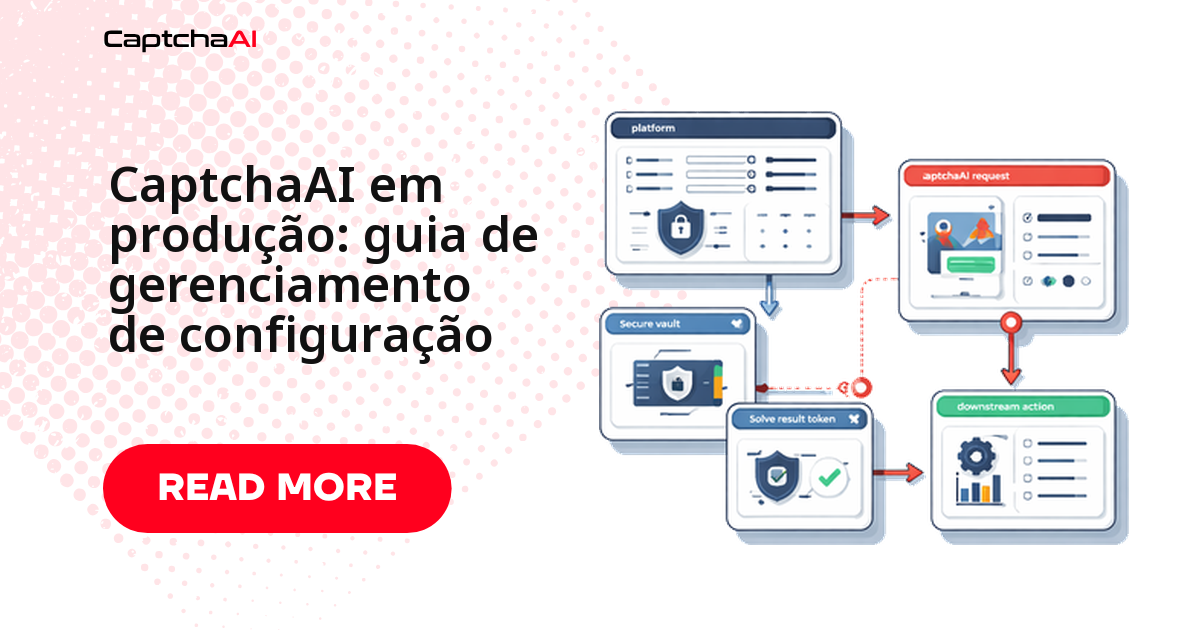
Qual variável ganha quando o .env, o arquivo YAML e o valor padrão do código dizem coisas diferentes? A resposta curta: a variável de ambiente sempre vence — e é em torno dessa regra que qualquer configuração de produção da CaptchaAI deveria ser desenhada.
Uma chave de API fixa no código funciona enquanto o projeto roda só na sua máquina. Quando a mesma integração passa a atender staging, produção e uma região secundária, esses valores precisam mudar sem novo deploy — e a chave sai do repositório.
Neste guia:
- hierarquia entre variável de ambiente, arquivo e padrão no código;
- referência completa de cada variável
CAPTCHAAI_*; - carregadores em Python e Node.js;
- onde guardar segredos e como versionar um YAML por ambiente;
- os erros de configuração mais comuns.
Qual configuração vale: variável de ambiente, arquivo ou padrão do código?
Priority (highest → lowest):

1. Environment variables     ← deployment-specific overrides
2. Config file (YAML/JSON)   ← version-controlled defaults
3. Application defaults      ← fallback values in code
Na prática: a variável de ambiente sobrescreve o arquivo de configuração, que sobrescreve os padrões embutidos no código. Se o serviço aceitar uma flag de linha de comando, coloque-a acima das variáveis de ambiente — o mesmo princípio se aplica: quem está mais perto do operador no momento do deploy tem prioridade.
Referência completa de configuração: todas as variáveis de ambiente da CaptchaAI
| Parâmetro | Variável de ambiente | Padrão | Descrição |
|---|---|---|---|
| Chave de API | CAPTCHAAI_API_KEY |
- | Obrigatório. Sua chave de API da CaptchaAI |
| Submit URL | CAPTCHAAI_SUBMIT_URL |
https://ocr.captchaai.com/in.php |
Endpoint de envio da tarefa |
| Poll URL | CAPTCHAAI_POLL_URL |
https://ocr.captchaai.com/res.php |
Endpoint de polling do resultado |
| Intervalo de polling | CAPTCHAAI_POLL_INTERVAL |
5 |
Segundos entre tentativas de consulta |
| Máximo de tentativas de polling | CAPTCHAAI_MAX_POLLS |
60 |
Tentativas de consulta antes do tempo limite |
| Concorrência | CAPTCHAAI_CONCURRENCY |
10 |
Máximo de tarefas CAPTCHA em paralelo |
| Tempo limite | CAPTCHAAI_TIMEOUT |
300 |
Tempo limite geral, em segundos |
| Proxy | CAPTCHAAI_PROXY |
- | URL do proxy usado na resolução do CAPTCHA |
| URL de callback | CAPTCHAAI_CALLBACK_URL |
- | URL do webhook para resultados assíncronos |
| Retentativas | CAPTCHAAI_RETRIES |
3 |
Novas tentativas em falhas transitórias |
| Nível de log | CAPTCHAAI_LOG_LEVEL |
info |
Verbosidade dos logs |
São os mesmos nomes de variável usados nos carregadores abaixo (Python e Node.js) e nos arquivos YAML por ambiente mais adiante.
Carregando a configuração em Python e Node.js
Os dois carregadores abaixo implementam a mesma hierarquia: leem o arquivo de configuração, sobrescrevem com as variáveis de ambiente e validam antes de devolver o objeto pronto.
Python
import os
import yaml
from dataclasses import dataclass, field
from pathlib import Path


@dataclass
class CaptchaAIConfig:
    api_key: str = ""
    submit_url: str = "https://ocr.captchaai.com/in.php"
    poll_url: str = "https://ocr.captchaai.com/res.php"
    poll_interval: int = 5
    max_polls: int = 60
    concurrency: int = 10
    timeout: int = 300
    proxy: str = ""
    callback_url: str = ""
    retries: int = 3
    log_level: str = "info"

    @classmethod
    def load(cls, config_path=None):
        """Load config: env vars override file, which overrides defaults."""
        config = cls()

        # Layer 2: Config file
        if config_path and Path(config_path).exists():
            with open(config_path) as f:
                file_config = yaml.safe_load(f) or {}
            for key, value in file_config.items():
                if hasattr(config, key):
                    setattr(config, key, value)

        # Layer 1: Environment variables (highest priority)
        env_map = {
            "CAPTCHAAI_API_KEY": "api_key",
            "CAPTCHAAI_SUBMIT_URL": "submit_url",
            "CAPTCHAAI_POLL_URL": "poll_url",
            "CAPTCHAAI_POLL_INTERVAL": "poll_interval",
            "CAPTCHAAI_MAX_POLLS": "max_polls",
            "CAPTCHAAI_CONCURRENCY": "concurrency",
            "CAPTCHAAI_TIMEOUT": "timeout",
            "CAPTCHAAI_PROXY": "proxy",
            "CAPTCHAAI_CALLBACK_URL": "callback_url",
            "CAPTCHAAI_RETRIES": "retries",
            "CAPTCHAAI_LOG_LEVEL": "log_level",
        }

        for env_key, attr_name in env_map.items():
            value = os.environ.get(env_key)
            if value is not None:
                # Cast to correct type
                current = getattr(config, attr_name)
                if isinstance(current, int):
                    value = int(value)
                setattr(config, attr_name, value)

        config.validate()
        return config

    def validate(self):
        if not self.api_key:
            raise ValueError("CAPTCHAAI_API_KEY is required")
        if self.poll_interval < 1:
            raise ValueError("poll_interval must be >= 1")
        if self.concurrency < 1:
            raise ValueError("concurrency must be >= 1")


# Usage
config = CaptchaAIConfig.load("config/captchaai.yaml")
print(f"Concurrency: {config.concurrency}, Timeout: {config.timeout}s")
JavaScript
const fs = require("fs");
const yaml = require("js-yaml");
const path = require("path");

class CaptchaAIConfig {
  static defaults = {
    apiKey: "",
    submitUrl: "https://ocr.captchaai.com/in.php",
    pollUrl: "https://ocr.captchaai.com/res.php",
    pollInterval: 5,
    maxPolls: 60,
    concurrency: 10,
    timeout: 300,
    proxy: "",
    callbackUrl: "",
    retries: 3,
    logLevel: "info",
  };

  static envMap = {
    CAPTCHAAI_API_KEY: "apiKey",
    CAPTCHAAI_SUBMIT_URL: "submitUrl",
    CAPTCHAAI_POLL_URL: "pollUrl",
    CAPTCHAAI_POLL_INTERVAL: { key: "pollInterval", type: "int" },
    CAPTCHAAI_MAX_POLLS: { key: "maxPolls", type: "int" },
    CAPTCHAAI_CONCURRENCY: { key: "concurrency", type: "int" },
    CAPTCHAAI_TIMEOUT: { key: "timeout", type: "int" },
    CAPTCHAAI_PROXY: "proxy",
    CAPTCHAAI_CALLBACK_URL: "callbackUrl",
    CAPTCHAAI_RETRIES: { key: "retries", type: "int" },
    CAPTCHAAI_LOG_LEVEL: "logLevel",
  };

  static load(configPath = null) {
    let config = { ...CaptchaAIConfig.defaults };

    // Layer 2: Config file
    if (configPath && fs.existsSync(configPath)) {
      const ext = path.extname(configPath);
      const raw = fs.readFileSync(configPath, "utf8");
      const fileConfig = ext === ".json" ? JSON.parse(raw) : yaml.load(raw);
      config = { ...config, ...fileConfig };
    }

    // Layer 1: Environment variables
    for (const [envKey, mapping] of Object.entries(CaptchaAIConfig.envMap)) {
      const value = process.env[envKey];
      if (value !== undefined) {
        const attrKey = typeof mapping === "string" ? mapping : mapping.key;
        const type = typeof mapping === "string" ? "string" : mapping.type;
        config[attrKey] = type === "int" ? parseInt(value, 10) : value;
      }
    }

    CaptchaAIConfig.validate(config);
    return config;
  }

  static validate(config) {
    if (!config.apiKey) throw new Error("CAPTCHAAI_API_KEY is required");
    if (config.pollInterval < 1) throw new Error("pollInterval must be >= 1");
    if (config.concurrency < 1) throw new Error("concurrency must be >= 1");
  }
}

// Usage
const config = CaptchaAIConfig.load("config/captchaai.yaml");
console.log(`Concurrency: ${config.concurrency}, Timeout: ${config.timeout}s`);
Um arquivo de configuração por ambiente: base, produção e staging
Em vez de um único arquivo cheio de if ambiente == "produção", mantenha um arquivo base com os valores conservadores e um arquivo por ambiente que só sobrescreve o que muda — mais fácil de revisar e mais difícil de subir staging com config de produção por engano.
Base (todos os ambientes)
# config/captchaai.yaml — base
api_key: ""  # Always set via env var
concurrency: 5
poll_interval: 5
retries: 3
log_level: info
Produção
# config/captchaai.production.yaml
concurrency: 20
poll_interval: 3
timeout: 180
log_level: warning
Staging
# config/captchaai.staging.yaml
concurrency: 3
poll_interval: 5
timeout: 300
log_level: debug
Em produção o poll_interval cai para 3 s e a concurrency sobe para 20. Se os workers rodam em sa-east-1 (São Paulo), meça o RTT real até os endpoints da CaptchaAI antes de copiar esses valores.
Gerenciamento de segredos: onde guardar a chave de API
Regra única, sem exceção:
- nunca guarde a chave de API em arquivo de configuração versionado;
- nunca faça commit dela em controle de origem, nem em um branch privado.
| Método | Ideal para | Exemplo |
|---|---|---|
| Variáveis de ambiente | Contêineres, CI/CD | export CAPTCHAAI_API_KEY=abc123 |
| AWS Secrets Manager | Infraestrutura AWS | Busca na inicialização; rotação automática |
| HashiCorp Vault | Múltiplas nuvens, on-premises | Segredos dinâmicos com TTL |
| Docker secrets | Docker Swarm / Docker Compose | Montado em /run/secrets/ |
Arquivo .env (só em dev) |
Desenvolvimento local | Biblioteca dotenv; adicione ao .gitignore |
Exemplo com Docker Compose
services:
  captcha-worker:
    image: captcha-worker:latest
    environment:

      - CAPTCHAAI_API_KEY=${CAPTCHAAI_API_KEY}
      - CAPTCHAAI_CONCURRENCY=15
      - CAPTCHAAI_LOG_LEVEL=warning
    env_file:

      - .env.production
Nota de conformidade: isso também é LGPD, não só segurança. Se o log de configuração ou de requisições grava a chave de API (ou dado que identifique um usuário) em texto puro, mascare o valor no output —
CAPTCHAAI_API_KEY=abc1***— antes de enviar para qualquer sistema de observabilidade.
Feature flags: mude o comportamento sem reimplantar
class FeatureFlags:
    def __init__(self):
        self.flags = {
            "use_callback": os.environ.get("FF_USE_CALLBACK", "false") == "true",
            "enable_proxy": os.environ.get("FF_ENABLE_PROXY", "true") == "true",
            "max_concurrent": int(os.environ.get("FF_MAX_CONCURRENT", "10")),
        }

    def is_enabled(self, flag):
        return self.flags.get(flag, False)

    def get(self, flag, default=None):
        return self.flags.get(flag, default)
Isso resolve um problema comum: ligar um recurso novo (por exemplo, callback em vez de polling) sem esperar o próximo deploy — trocar FF_USE_CALLBACK para true no orquestrador já basta.
Erros comuns de configuração e como resolver
A maioria dos chamados cai em duas categorias: não carrega ou carrega o valor errado.
| Problema | Causa provável | Como resolver |
|---|---|---|
| Chave de API não carrega | Variável de ambiente ausente ou nome digitado errado | Rode echo $CAPTCHAAI_API_KEY e confira a grafia exata |
| Arquivo de configuração é ignorado | Caminho incorreto ou biblioteca YAML não instalada | Confirme que o arquivo existe; instale pyyaml ou js-yaml |
| Produção sobe com valores de desenvolvimento | O override específico do ambiente não foi aplicado | Confira a ordem de precedência das env vars e o valor de NODE_ENV / APP_ENV |
| Segredos aparecem nos logs | O dump de configuração inclui a chave de API sem máscara | Mascare os campos sensíveis antes de gravar qualquer log |
Perguntas frequentes
Qual valor vence se eu definir a mesma chave na variável de ambiente e no YAML?
A variável de ambiente. É a camada mais próxima do deploy, então sobrescreve o arquivo de configuração e os padrões do código.
Posso usar o arquivo .env direto em produção?
Não é recomendado. .env é prático em dev, mas em produção prefira variáveis injetadas pelo orquestrador (Kubernetes, ECS) ou um gerenciador de segredos como AWS Secrets Manager ou HashiCorp Vault.
Como evito que a chave de API vaze nos logs?
Mascare o valor antes de logar qualquer dump de configuração (mostre só os últimos caracteres, ***c123) e confira se o middleware de log não grava o header Authorization por padrão.
Preciso reiniciar o worker depois de mudar a concorrência?
Não, se o serviço ler a configuração a cada lote de tarefas, não só na inicialização. Basta atualizar CAPTCHAAI_CONCURRENCY e enviar um sinal de recarga.
YAML ou JSON: qual formato usar no arquivo de configuração?
YAML para arquivos editados por humanos — aceita comentários. JSON quando a configuração é gerada por outro sistema ou você quer uma análise mais rígida.
Artigos relacionados
- Configuração de proxy SOCKS5 na CaptchaAI
- Gerenciamento de chaves de API multiusuário para equipes
- Guia de configuração de proxy da CaptchaAI
Próximas etapas
Leve sua configuração para produção: gere uma chave de API da CaptchaAI e monte os três arquivos YAML a partir dos modelos deste guia.
Guias relacionados: